

Market Intelligence
Market Intelligence now lives as the demand section of Smart Pricing, showing which products are rising or falling and how that should influence price decisions.
At a glance
The numbers on your screen, explained
What each Market Intelligence number means and where it comes from — so you know where to act.
Real margin provides the margin context needed before interpreting rising or falling demand.
Below target counts products that may need price or cost review before demand signals are acted on.
Cost rises not passed on counts products with supplier cost increases that are not reflected in price.
Profit opportunity estimates the monthly lift from pricing recommendations that account for demand and margin.
Sample numbers from a demo workspace.
Demand
See what is rising and falling before changing prices
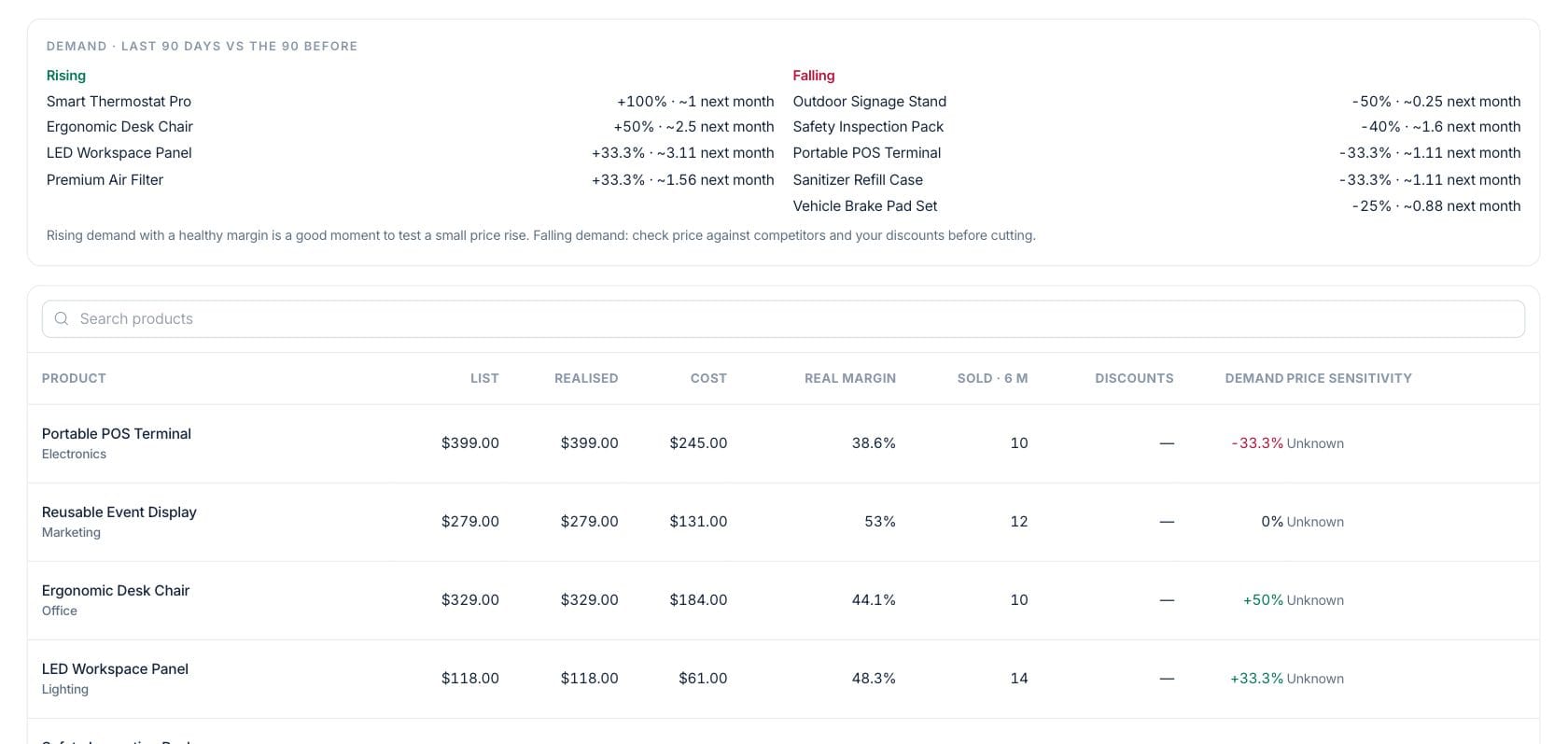
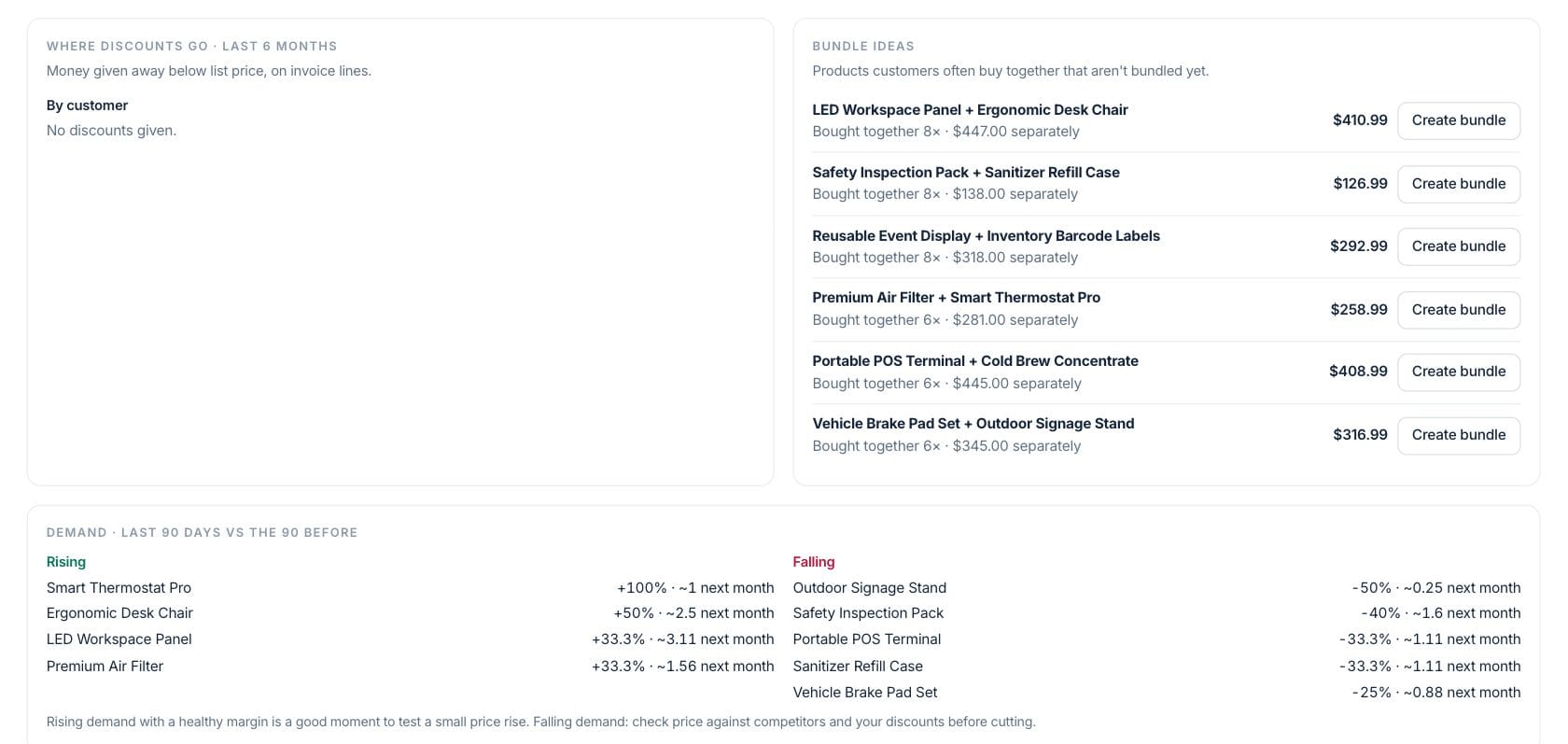
The demand section compares the last 90 days with the previous 90 days and lists rising and falling products with expected next-month units.
- Rising products show percentage increase and next-month expectation
- Falling products show decline and expected units
- Guidance explains when to test price changes or review discounts
Pricing context
Tie demand to margin, cost, and discount behavior
Demand is shown inside Smart Pricing so you can compare product momentum with list price, realised price, cost, margin, units sold, discounts, and price sensitivity.
- Avoid cutting price without checking discount leakage first
- Spot rising products with healthy margin for careful price tests
- Review cost changes before judging demand alone
Product table
Open product-level evidence from one demand view
The full product table combines demand percentage, sensitivity, margin, sales volume, cost, and discount rate so owners can decide which products deserve review.
- Search products and open detail drawers
- Sensitivity is labeled as measured, similar-product, or unknown
- Open source products when a decision needs editing
Everything included
Everything in Market Intelligence
Use it for planning cycles, competitor review, positioning, and market opportunity research.
Rising demand list
See products gaining demand in the latest 90-day comparison.
Falling demand list
Spot products losing demand so you can review price, discount, or offer fit.
Price context
Demand is reviewed alongside list price, realised price, and suggested price changes.
Margin context
Real margin and target margin help keep demand decisions profitable.
Discount context
Discount leakage helps explain whether demand was bought with lower prices.
Product-level table
Search products and compare cost, sold units, discounts, demand, and sensitivity.
Sensitivity labels
See whether price sensitivity is measured, inferred from similar products, or unknown.
AI price questions
Ask AI about a product using margin, demand, cost, and sensitivity context.
How it works
Market Intelligence, step by step
- 01
Open Smart Pricing
Market-style demand signals are now part of the Smart Pricing workspace.
- 02
Review rising and falling products
Compare demand in the last 90 days with the 90 days before and note expected next-month units.
- 03
Check margin and discounts
Use the pricing KPIs and product table before deciding whether demand supports a price change.
- 04
Open product details
Inspect the product drawer, ask AI, or open the product record when you are ready to act.
Connected
Works with the rest of Fratelli
The same records flow between these workspaces automatically.
FAQ
Market Intelligence questions
Can’t find what you need? Our team is happy to help.
It is represented in the current product as the demand section inside Smart Pricing, not as a separate standalone workspace.
No external competitor feed is shown in the current workspace. It focuses on your own product demand, cost, margin, discounts, and sensitivity.
Use it with margin and discount context. Rising demand with healthy margin may support a small price test; falling demand should prompt review before cutting price.
Try Market Intelligence with the rest of Fratelli
Start free in minutes and bring the rest of your team when you are ready.