

Cash Flow Forecast
Project cash over the next 13 weeks, inspect what drives each week, test what-if scenarios, and act on recommended fixes.
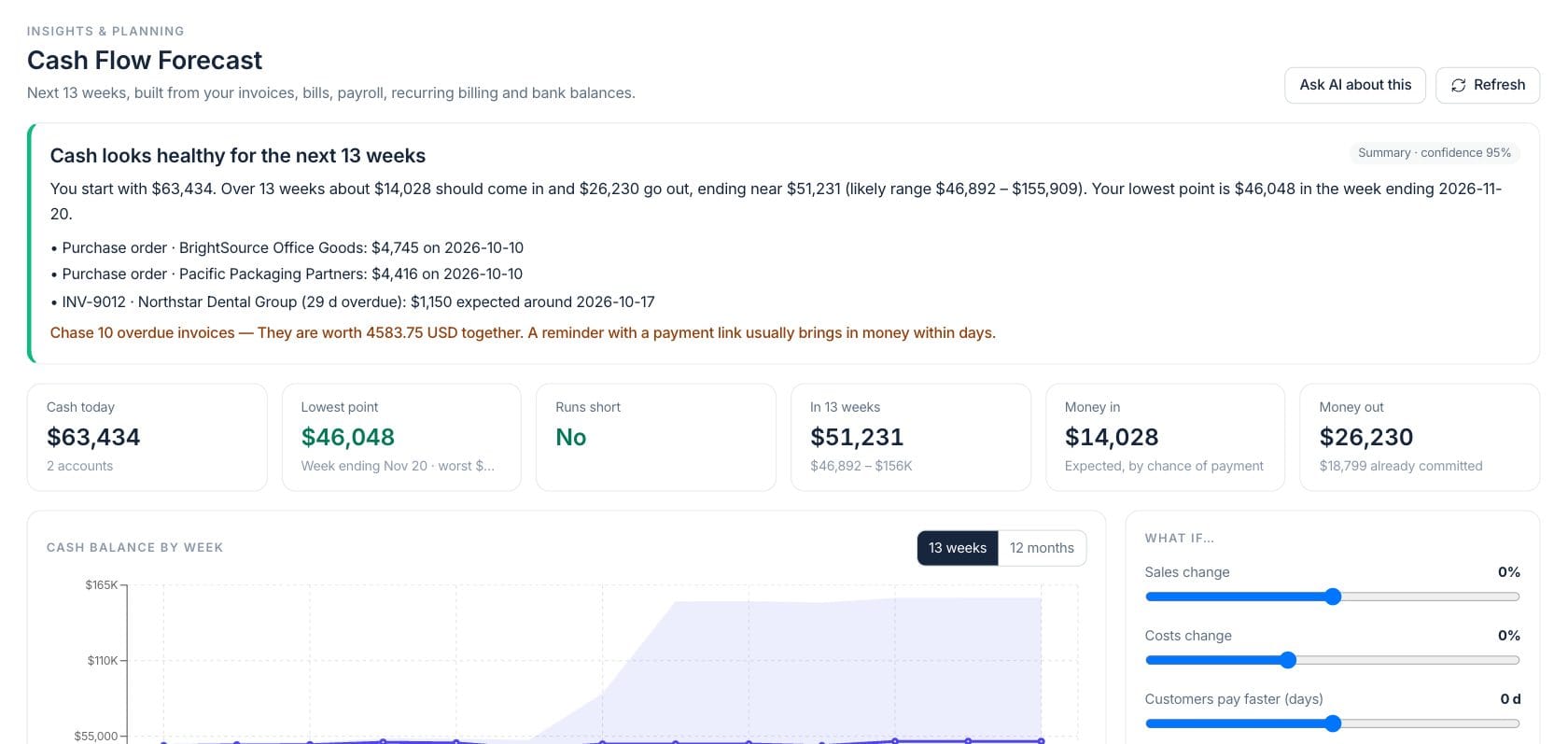
At a glance
The numbers on your screen, explained
What each Cash Flow Forecast number means and where it comes from — so you know where to act.
Cash today is the starting balance from connected cash sources used by the forecast.
Lowest point is the smallest expected closing cash balance in the 13-week projection.
Runs short flags whether expected or worst-case cash falls below zero during the forecast.
Money out totals expected bills, payroll, recurring costs, purchase orders, taxes, and baseline spend.
Sample numbers from a demo workspace.
Forecast
See the next 13 weeks with likely ranges
The forecast combines bank balances, invoices, bills, payroll, recurring billing, purchase orders, expected new sales, pipeline, taxes, and recent spending into a week-by-week cash view.
- Expected balance line sits inside a likely range
- Money in and money out are shown by week or by month
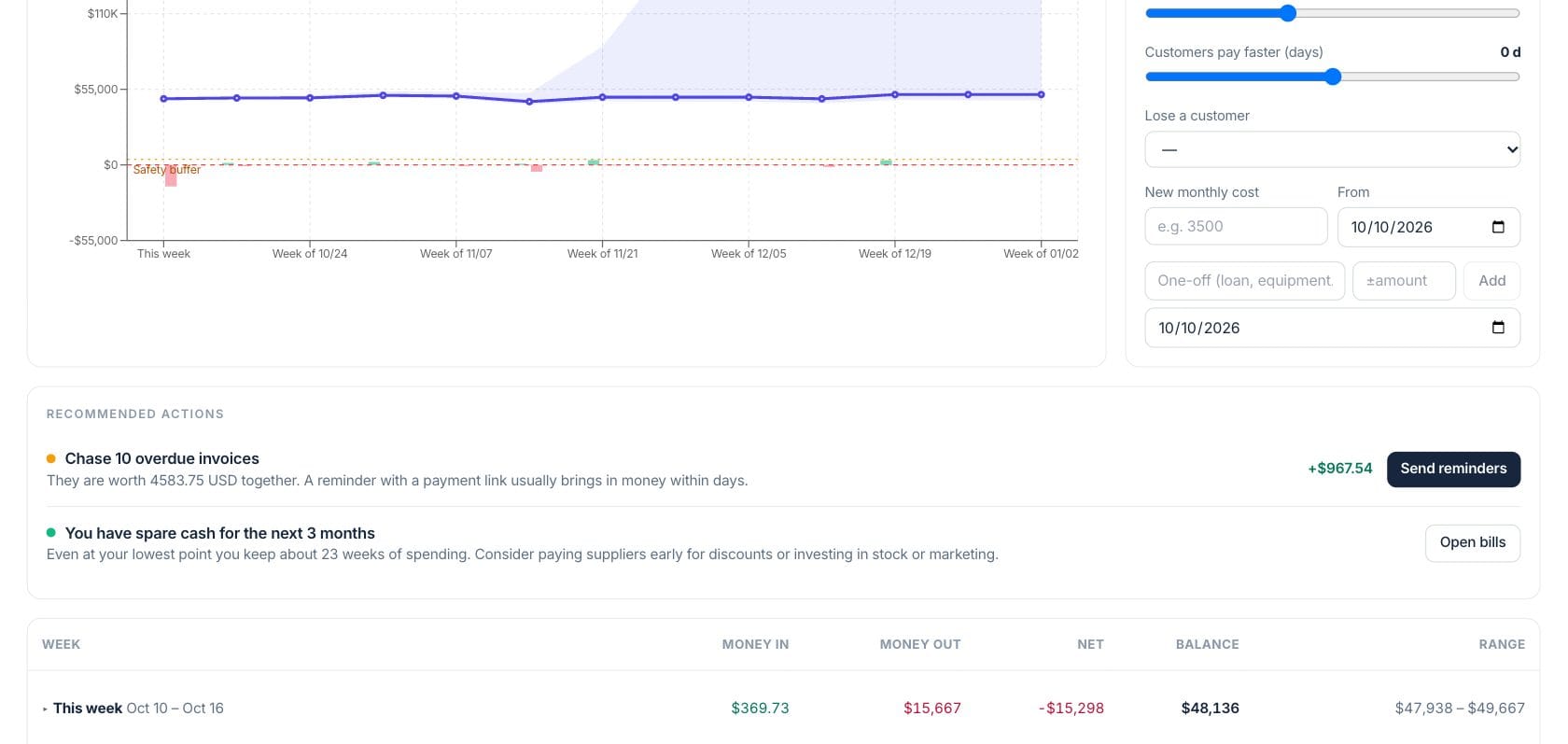
- Safety buffer and zero line make pressure points easy to spot
What-if
Test scenarios before you commit
Change sales, costs, collection speed, lost customers, new monthly costs, or one-off inflows and outflows to see how cash changes instantly.
- Compare lowest point and ending cash against the current plan
- Ask AI about a scenario from the forecast screen
- Reset scenarios without changing source records
Fixes
Turn forecast risks into practical actions
Recommended actions explain the cash issue and link to the work that can improve it, such as sending overdue invoice reminders or opening bills.
- Recommended actions show the expected cash value
- Week rows list money in, money out, net, balance, and range
- Source references can open invoices, bills, purchase orders, deals, or recurring billing
Everything included
Everything in Cash Flow Forecast
Use it for short-term planning, collection priorities, payment timing, and scenario review.
13-week cash forecast
Project weekly cash balances from current balances and dated business records.
Money in and out
Separate expected receipts from obligations and spending so timing is clear.
Likely range
Low, expected, and high balances help you see uncertainty rather than one rigid number.
What-if controls
Model changes to sales, costs, collections, customers, and one-off events.
AI explanation
A summary explains why cash looks healthy or risky, grounded in forecast facts.
Source-linked items
Open invoices, bills, purchase orders, deals, and recurring billing from forecast drivers.
Recommended fixes
Actions such as payment reminders are surfaced where they affect cash.
Refreshable model
Rebuild the forecast when new documents or balances change the picture.
How it works
Cash Flow Forecast, step by step
- 01
Review the forecast summary
Start with cash today, lowest point, whether cash runs short, money in, money out, and the AI summary.
- 02
Inspect the chart and week rows
Look at the expected balance, likely range, source items, net cash movement, and balance by week.
- 03
Try a scenario
Adjust sales, costs, collection speed, lost customers, new monthly costs, or one-off events to test decisions.
- 04
Act on fixes
Use recommended actions or source links to send reminders, review bills, or open the record affecting cash.
Connected
Works with the rest of Fratelli
The same records flow between these workspaces automatically.
FAQ
Cash Flow Forecast questions
Can’t find what you need? Our team is happy to help.
No. It starts with cash balances and layers in invoices, bills, payroll, recurring billing, purchase orders, pipeline, taxes, and recent spending patterns.
No. What-if changes run in the browser as planning scenarios and can be reset without editing invoices, bills, customers, or products.
Yes. It shows low, expected, and high ranges, plus quality notes when better data such as connected bank balances would improve confidence.
Try Cash Flow Forecast with the rest of Fratelli
Start free in minutes and bring the rest of your team when you are ready.